Who Were the Forty-Eighters?
The Forty-Eighters, also written 48ers, were European, primarily German, political activists who participated in or supported the Revolutions of 1848. When those revolutions failed, they faced arrest, imprisonment, or exile. Choosing a republic over a monarchy, tens of thousands emigrated, and between 4,000 and 10,000 of them made the United States their new home.
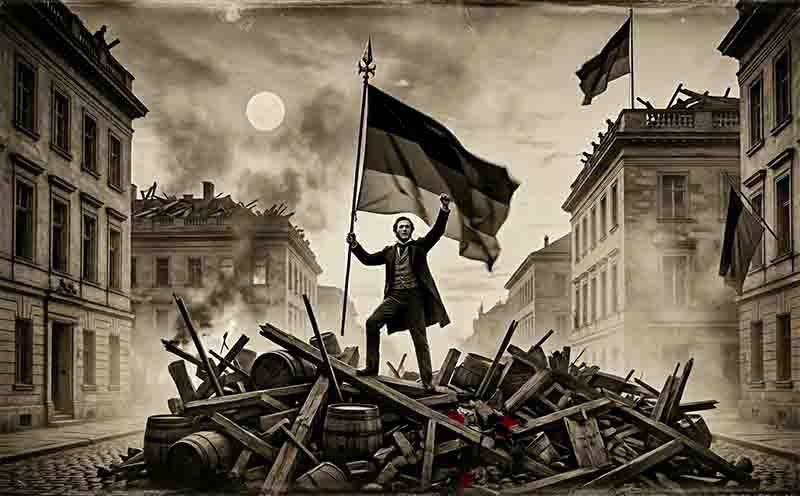
They were unlike the broad wave of German economic emigrants of the same era. The Forty-Eighters came not from poverty or famine, but from classrooms, courtrooms, editorial offices, and barricades. They were lawyers, professors, physicians, journalists, and officers, well-educated, politically sophisticated, and deeply committed to the democratic ideals they had failed to establish in Germany. In America, they found a republic aligned with those ideals, and they set about shaping it.
What did the Forty-Eighters actually do in America? In the short term: they organized German-American voters behind the new Republican Party, campaigned for Lincoln, founded German-language newspapers, and volunteered in disproportionate numbers for the Union Army. In the long term: they established the first kindergartens in America, built the Turnvereine gymnastic-political clubs that became German-American civic infrastructure, introduced bilingual public education, and shaped the "German vote" that influenced national politics for a generation. A 2021 peer-reviewed study in the American Economic Review provided causal evidence that Forty-Eighter leadership measurably increased Union Army enlistment rates in German-American communities.
The German Revolution of 1848: Why It Failed
The revolutions that swept Europe in 1848 were fed by a combustible mixture of economic misery and political frustration. In the German states, the potato blight of 1846–47 had caused crop failures and industrial depression, while artisans chafed under guild restrictions and intellectuals demanded freedom of speech, freedom of the press, and representative government.
In March 1848, revolts broke out across the German Confederation. The Frankfurt National Assembly convened in May 1848, the first freely elected pan-German parliament in history, and spent over a year attempting to draft a liberal constitution for a unified Germany. By June 1849, the effort had collapsed. King Friedrich Wilhelm IV of Prussia rejected the Assembly's offer of a unified German crown, Austrian and Prussian troops suppressed the remaining revolutionary governments in Baden and the Palatinate, and the Frankfurt parliament was dissolved.
🏛️ The Frankfurt National Assembly: Key Facts
Convened May 18, 1848 in Frankfurt's Paulskirche. Membership: approximately 831 delegates, mostly lawyers, professors, and educated professionals. Duration: May 1848 – June 1849. Primary goal: draft a constitution for a unified, democratic German state. Outcome: dissolved after Friedrich Wilhelm IV rejected the offered imperial crown. Consequence: thousands of participants faced prosecution and emigrated.
The revolutionaries had not been overthrown, they had been outmaneuvered. The Prussian and Austrian monarchies agreed to grant limited constitutions to defuse the immediate pressure, then retracted those concessions once their armies were secure. For the men and women who had risked everything, the choice was stark: recant, face prison, or leave.
Who They Were: Education, Class, and Ideology
The Forty-Eighters were not a homogeneous group, but they shared several distinguishing characteristics that set them apart from other German emigrants of the era.
Highly Educated
Many held university degrees or professional training. Historians documented lawyers, physicians, engineers, journalists, pastors, and military officers among the 48er cohort. In Watertown, Wisconsin, documented 48ers included a Heidelberg student, a Göttingen-trained physician, and a Northwestern College professor.
Politically Radical
Forty-Eighters spanned a spectrum from liberal constitutionalists to outright republicans and socialists. They almost universally opposed slavery, supported secular public education, and championed freedom of the press. Many were freethinkers or agnostics, which sometimes put them at odds with more conservative German-American religious communities.
Financially Resourced
Unlike purely economic emigrants, many Forty-Eighters arrived with capital, professional skills, and social networks. This enabled them to found newspapers, law practices, and businesses far more quickly than impoverished rural emigrants. Their resources amplified their political and cultural influence beyond their raw numbers.
Their social origins mattered. Most came from the Bildungsbürgertum, the educated bourgeoisie of the southwestern German states: Baden, Württemberg, the Palatinate, Hesse, and the Rhineland. Many were young men in their twenties and thirties. The editors of the A.E. Zucker compilation The Forty-Eighters (1950), drawing on eleven academic contributors, assembled lists of several hundred confirmed 48er emigrants, a roster that includes six confirmed Texas emigrants alone.
Why America? The Emigration Decision
The Forty-Eighters chose the United States over other potential destinations, Britain, France, Switzerland, Australia, for reasons that were as much ideological as practical. The United States was a republic founded on a Declaration that proclaimed "all men are created equal." Its lack of immigration restrictions and its offer of citizenship were concrete expressions of the political principles the 48ers had fought for.
🌍 Why the USA, Not Elsewhere?
- No immigration laws: The United States imposed no immigration restrictions in the 1850s. Arrival and citizenship were straightforward for Europeans.
- Republican government: The U.S. was the world's most prominent functioning republic, an ideological match for 48er values.
- Existing German communities: Letters from earlier German settlers in Ohio, Indiana, Wisconsin, and Texas described cheap land, minimal taxation, and political freedom.
- No military conscription: A key grievance in Germany was forced military service. Johann Wolfgang Schreyer, an 1843 settler in Indiana, wrote home that there was no draft and taxes were minimal, letters that were widely circulated in Germany.
- Land availability: Public land was free of taxation for the first five years. For educated men with capital, starting over in America was genuinely feasible.
Britain attracted some, notably Carl Schurz briefly before his final departure for America. Switzerland sheltered others temporarily. But the gravitational pull of America, land of the Declaration of Independence and the Constitution, proved decisive for the majority.
Where They Settled: The German-American Heartland
The Forty-Eighters did not disperse randomly. They clustered in cities and regions with existing German-speaking communities, where they quickly assumed leadership roles in German-American organizations, newspapers, and political clubs.
Visual Timeline: The Forty-Eighters in America (1848–1870)
The following timeline traces the key events from the failed Revolution through the decisive impact of the 48ers on the American Civil War and its aftermath.
Barricade fighting breaks out across the German states. King Friedrich Wilhelm IV of Prussia temporarily grants a constitution. Frankfurt National Assembly convenes in May.
The Frankfurt National Assembly is dissolved. Prussian and Austrian troops suppress the last revolutionary governments. The emigration of politically active Germans, the Forty-Eighters, accelerates sharply.
The majority of Forty-Eighters arrive in the United States via Hamburg and Bremen, entering through Galveston, New York, and Baltimore. They join existing German communities in Ohio, Missouri, Wisconsin, and Texas.
Forty-Eighters lead violent protests against the visiting papal emissary Cardinal Gaetano Bedini, who had suppressed revolutionaries in the Papal States. One demonstrator is killed. The episode illustrates the anti-clerical radicalism of the 48er community.
Forty-Eighters become early and energetic supporters of the new Republican Party, founded 1854. Carl Schurz, Friedrich Hecker, and others campaign in German-language press and mass meetings, helping construct a "German vote" the party cannot ignore.
Margarethe Meyer Schurz opens the first kindergarten in the United States in Watertown, Wisconsin, following Fröbelian educational principles. The concept spreads nationally within a decade, transforming American early childhood education.
Carl Schurz campaigns actively for Lincoln in German-speaking communities across the Midwest. The German-American vote, organized in part by 48er networks, contributes to Lincoln's margins in key states including Illinois, Indiana, and Ohio.
The outbreak of the Civil War sees Forty-Eighters take leading roles in recruiting German-American regiments. Franz Sigel's popularity as a Union general becomes a rallying cry. In Texas, German Unionists, many of them 48ers or their associates, attempt to flee to Mexico; 36 are killed at the Battle of the Nueces River (August 1862).
Carl Schurz commands a division at Chancellorsville and Gettysburg. August Willich becomes one of the Union Army's most effective brigade commanders in the Western Theater. The 48er military cadre provides experienced leadership throughout the war.
Carl Schurz is elected U.S. Senator from Missouri, the first person born in Germany to serve in the U.S. Senate. He subsequently serves as Secretary of the Interior (1877–1881) under President Hayes, championing civil service reform and Native American rights.
Key Figures: The Forty-Eighters Who Made History
The most prominent 48er in American public life. Helped Lincoln win the 1860 election. U.S. Senator (Missouri). Secretary of the Interior. Called by historians "the most influential U.S. citizen of German birth."
Wife of Carl Schurz and a Forty-Eighter in her own right. Founded the first American kindergarten in Watertown, Wisconsin, 1856, following Fröbel's methods.
Former Baden revolutionary general. Union Army Major General. The rallying cry "I fights mit Sigel" made him the most recognized German-American military figure of the Civil War.
Former Prussian officer and communist revolutionary (Karl Marx called him "the reddest of the red"). Became one of the most effective Union brigade commanders in the Western Theater.
Lawyer and revolutionary leader of the Baden uprising. Settled in Illinois, farmed, and remained a powerful orator who mobilized German-American support for the Union.
Member of the Frankfurt National Assembly. Texas Unionist and abolitionist. Elected to two Texas constitutional assemblies and served in the U.S. Congress during Reconstruction.
Settled in Sisterdale, Texas. Introduced and championed the kindergarten system in the United States independently alongside Margarethe Schurz. Later abolitionist newspaper editor.
Led the Baden provisional government in 1849. Emigrated to Illinois, became a journalist and politician. Served in the U.S. Congress (1877–1879).
The Forty-Eighters and the Civil War
No aspect of the Forty-Eighters' American legacy has attracted more recent scholarly attention than their role in the Civil War. As men who had fought against aristocratic tyranny in Europe, the 48ers viewed slavery as the American incarnation of the oppression they had opposed at home. Their anti-slavery commitment was not rhetorical, it translated into action.
The Political Campaign for Lincoln
Carl Schurz was the most visible 48er in the 1860 presidential campaign. He traveled across the Midwest delivering speeches in German and English, framing Lincoln's candidacy in terms that resonated with German-American values: opposition to the extension of slavery, free soil and free labor, and the integrity of the republic. His efforts were considered pivotal in delivering German-American votes in swing states.
⚔️ Forty-Eighter Military Officers in the Civil War
Carl Schurz commanded a division at Chancellorsville (May 1863) and Gettysburg (July 1863). Franz Sigel commanded a corps in the Army of Virginia. August Willich's brigade was distinguished in the Western Theater at Shiloh, Perryville, Stones River, Chickamauga, and Atlanta. Friedrich Hecker organized Illinois German regiments. Ludwig Blenker commanded a division in the Army of the Potomac. These officers and dozens of colonels and regiment commanders provided the German-American community with its own military heroes, a critical factor in sustaining enlistment.
The Texas Tragedy: The Battle of the Nueces (1862)
The radicalism of Texas Forty-Eighters came at a lethal cost. When the Confederacy imposed martial law on the Texas Hill Country in 1862, a group of young German Unionists, many connected to 48er families, attempted to flee to Mexico to reach Union lines. On August 10, 1862, Confederate troops overtook them at the Nueces River. Of approximately 68 men, 36 were killed in the attack or executed afterward. Eduard Degener, whose two sons were among the dead, was imprisoned in San Antonio. A monument at Comfort, Texas, the Treue der Union ("Loyalty to the Union"), remains one of the few Confederate-era monuments to Union loyalty in the Deep South.
📊 Peer-Reviewed Research: The Measurable Impact
A landmark 2021 study published in the American Economic Review by economists Christian Dippel (UCLA Anderson School) and Stephan Heblich provided the first causal, quantitative evidence of the Forty-Eighters' political impact. Using the geographic distribution of 48er settlement as a natural experiment, the study found that counties with higher Forty-Eighter density showed measurably higher Union Army enlistment rates among German-Americans, demonstrating that 48er leadership converted community sympathy into action.
A companion NBER Working Paper (w24656) by the same authors contains the full regression analysis and dataset.
Cultural and Institutional Impact
The Forty-Eighters' influence extended far beyond politics and the battlefield. They were institution builders who left structural marks on American civic, educational, and cultural life.
German-Language Press
48ers founded and edited dozens of German-language newspapers, including the Neue Zeit (New York), St. Louis Anzeiger des Westens, and many others. In Milwaukee, German-language newspaper circulation doubled that of English-language papers by the late 19th century. These papers served as organizing tools for both anti-slavery agitation and Republican Party mobilization.
The Turnvereine (Turner Clubs)
The 48ers were instrumental in expanding the Turnverein gymnastic-political clubs across America. Founded in Germany in 1811, the Turners were simultaneously athletic organizations and radical political clubs. The Nord-Amerikanischer Saengerbund was established 1849. Turner halls became centers of German-American civic life and Republican organizing. Several Turner units formed Civil War regiments.
Education Reform
48ers strongly supported bilingual German-English public education and secular school systems. Margarethe Meyer Schurz opened the first kindergarten in the USA (Watertown WI, 1856). Carl Daniel Adolph Douai championed the kindergarten concept independently. The 48er push for physical education, drawn from Turnverein ideology, contributed to physical education's adoption in American public schools.
Beer, Wine & Agriculture
German immigrants including 48ers developed the beer and wine industries in Cincinnati, Milwaukee, St. Louis, and the Texas Hill Country. Their agricultural skills, particularly the use of fertilizers to restore over-cropped land, made them notably more productive farmers than competing ethnic groups in Wisconsin and Ohio, as documented by contemporary local historians.
Labor Rights & Civil Service Reform
Throughout the second half of the 19th century, Forty-Eighters and their successors advocated for improved labor laws and working conditions. Carl Schurz, as Secretary of the Interior, championed civil service reform, replacing patronage with merit-based appointments, a direct expression of the anti-aristocratic values of 1848.
Arts, Theater & Music
48ers contributed to German-American cultural institutions including Philharmonic orchestras, German-speaking theaters, and choral societies (Gesangvereine). These institutions served both as cultural preservation and as community social infrastructure, particularly in cities like Cincinnati, St. Louis, and Milwaukee.
2026 Research, Scholarship, and Continuing Relevance
The Forty-Eighters in 2026: Why This History Matters Now
The story of the Forty-Eighters has attracted renewed scholarly and public attention in the 2020s, partly because it speaks directly to contemporary questions about political exile, democratic backsliding, and the role of immigrant communities in sustaining democratic institutions.
The America 250 commemoration (2026), marking the 250th anniversary of the Declaration of Independence, has placed German-American contributions to the founding and preservation of the republic in sharper focus. Initiatives from the German-American Heritage Foundation (GAHF) and the Smithsonian Institution are highlighting the 48er legacy as a case study in how political refugees can strengthen a democracy rather than destabilize it.
The Sophienburg Museum in New Braunfels, the Texas State Historical Association (TSHA), and the Watertown Historical Society continue to curate primary-source research on Forty-Eighter individuals, providing documentary resources for genealogical and academic research that were not previously consolidated.
Key Academic Sources (Peer-Reviewed, 2018–2026)
- Dippel, C. & Heblich, S. (2021). "Leadership in Social Movements: Evidence from the 'Forty-Eighters' in the Civil War." American Economic Review, 111(2), 750–782. DOI: 10.1257/aer.20191137, Causal evidence that 48er settlement density increased Union Army enlistment.
- Dippel, C. & Heblich, S. (2018). NBER Working Paper No. w24656. Full dataset and regression analysis companion to the AER article.
- Lich, G.E. (1995, updated 2019). "Forty-Eighters." Handbook of Texas Online, Texas State Historical Association. Definitive Texas-specific reference with author attribution.
- Zucker, A.E., ed. (1950). The Forty-Eighters: Political Refugees of the German Revolution of 1848. Columbia University Press. Foundational academic compilation; eleven-contributor prosopography of several hundred confirmed 48ers.
- Brancaforte, C.L., ed. (1989). The German Forty-Eighters in the United States. Lang. Multi-author academic collection.
- Sophienburg Museum & Archives (2021). Boardman, K.H. "New Braunfels Forty-Eighters." Local primary-source profiles of five confirmed New Braunfels 48ers with primary citations.
Frequently Asked Questions
The name "Forty-Eighters" refers to the year 1848, when the Revolutions of 1848 swept across Europe. The German term is Achtundvierziger. The label applies specifically to those who were politically active in the revolutionary movements and subsequently emigrated, not to the broader wave of German economic migrants of the same era. In the United States, the term most commonly refers to the German 48ers, though the revolutions also produced Hungarian, Czech, and Italian exiles who emigrated to America.
The distinction from economic emigrants matters: the Forty-Eighters emigrated for explicitly political reasons, brought professional skills and capital, and arrived with a pre-formed ideological agenda that they pursued in their new country.
Estimates range from 4,000 to 10,000 Forty-Eighters who emigrated to the United States, out of the much larger wave of roughly 1 million German immigrants who arrived between 1845 and 1860. The Forty-Eighters were numerically a small fraction of total German emigration, perhaps less than 1%, but their political education, professional skills, and organizing capacity gave them an influence vastly disproportionate to their numbers.
Exact figures are elusive because U.S. immigration records of the period did not distinguish political from economic emigrants. The A.E. Zucker compilation (1950) documented several hundred named individuals; local historical records in cities like Watertown, Wisconsin (62 documented) and Texas Hill Country communities provide ground-level verification.
The historical consensus is that the German-American vote, significantly organized and mobilized by Forty-Eighter networks, was a meaningful factor in Lincoln's 1860 victory, particularly in Midwestern swing states. Carl Schurz was the most prominent campaigner, traveling extensively and speaking to German-American audiences across Illinois, Indiana, Ohio, and Wisconsin.
The causal relationship was formalized by the 2021 Dippel and Heblich study in the American Economic Review, which demonstrated that counties with higher concentrations of Forty-Eighter settlers showed statistically higher rates of German-American political mobilization, providing quantitative support for the historical narrative.
Yes. Margarethe Meyer Schurz, a Forty-Eighter herself and wife of Carl Schurz, opened the first kindergarten in the United States in Watertown, Wisconsin, in 1856, following the educational philosophy of Friedrich Fröbel. The kindergarten concept subsequently spread across America, largely through the advocacy of German-American educators.
Carl Daniel Adolph Douai, a Forty-Eighter who first settled in Sisterdale, Texas, is also credited with independently introducing and advocating for the kindergarten system in the United States, and is sometimes cited alongside Margarethe Schurz as a co-founder of the American kindergarten movement. The TSHA Handbook of Texas (Lich, 1995/2019) specifically names Douai as "introducer of the kindergarten system to the United States."
Texas Forty-Eighters, concentrated in the Hill Country towns of Sisterdale, New Braunfels, Fredericksburg, and Comfort, were almost universally Unionist and opposed to both slavery and secession. This put them in acute danger after Texas voted to secede in 1861.
The most dramatic episode was the Battle of the Nueces (August 10, 1862): a group of approximately 68 young German Unionists, many from 48er families, attempted to flee to Mexico to reach Union forces. Confederate troops overtook them at the Nueces River. 36 men were killed in the attack or executed afterward. Eduard Degener, a confirmed Forty-Eighter and former Frankfurt National Assembly member whose two sons were among the dead, was imprisoned.
The Turnvereine (singular: Turnverein) were German gymnastic clubs originally founded in Germany in 1811 by Friedrich Ludwig Jahn to promote physical fitness and nationalist consciousness. In the United States, they were transformed by Forty-Eighter leadership into simultaneously athletic and political organizations.
The 48ers used Turner halls as meeting places for Republican Party organizing, abolitionist agitation, and German-American community events. The Turner movement's political radicalism, anti-clerical, pro-labor, anti-slavery, reflected 48er ideology. The Nord-Amerikanischer Saengerbund (North American Singers' Federation) was established in 1849 as a parallel choral institution. Several Turner clubs formed entire Civil War regiments. The Turnvereine remained significant German-American institutions into the early 20th century.
No. The Revolutions of 1848 were pan-European, and political exiles emigrated from Hungary, the Czech lands, the Italian states, and other territories, as well as from the German Confederation and Austria. The term "Forty-Eighters" as used in American historical context most commonly refers to the German cohort, which was the largest and most organizationally influential in the United States.
Notable non-German 48ers who emigrated to America include Hungarian revolutionaries who formed their own exile communities. The German 48ers, however, had an advantage in numbers and community infrastructure: they emigrated into an existing network of German-American settlements that gave them an immediate organizational base.
Several authoritative resources are available for genealogical research into Forty-Eighter ancestry:
- A.E. Zucker, ed., The Forty-Eighters (1950). Columbia University Press. Contains a prosopographic list of several hundred confirmed 48er emigrants. Available in university libraries and via interlibrary loan.
- Texas State Historical Association (TSHA) Handbook of Texas, tshaonline.org Texas-specific entries with bibliographies.
- Sophienburg Museum & Archives, New Braunfels, TX. Primary source documentation on New Braunfels-area 48ers.
- Watertown Historical Society, Watertown, WI. Documents at least 62 confirmed Watertown 48ers with biographical details.
- Library of Congress and National Archives. Federal passenger lists, naturalization records, and Civil War service records.
- German-American Heritage Foundation (GAHF), gahmusa.org. Research resources and museum collections.

Explore More German American History
From the Forty-Eighters to Baron von Steuben and the 40 million Americans who claim German heritage today, discover how German immigrants shaped the United States from 1776 to the present.
German American History Submit Research40 Million Americans Claim German Heritage
Explore DemographicsArchitect of the American Army
Baron von SteubenThis article is provided for educational, historical, and genealogical research purposes. Primary source documents referenced are available at the Library of Congress, National Archives, TSHA Handbook of Texas, German-American Heritage Museum (GAHF), and Sophienburg Museum & Archives. Content last reviewed March 2026.