German American Demographics
The Largest Ancestry Group in the U.S.
German American demographics refer to the population characteristics of people in the United States with German ancestry.
Source: | United States Census
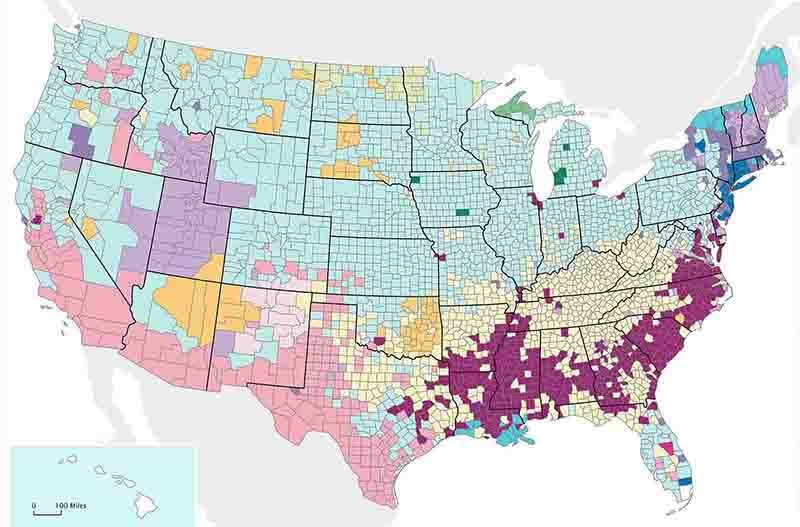
A chart of the top ancestries in the US, as provided by the 2000 census. Light blue shows counties predominated by ethnic Germans.
Statistics and Facts: The German American Population
German Americans make up one of the largest ethnic groups in the United States, with over 40 million people claiming German ancestry.
This accounts for approximately 13% of the total U.S. population, based on U.S. Census data.
States with the highest proportions of German-Americans tend to be those of the upper Midwest, including Iowa, Minnesota, Nebraska, Wisconsin, and the Dakotas; all at over 30%.
Of the four major US regions, German was the most-reported ancestry in the Midwest, second in the West and third in both the Northeast and the South.
German was the top reported ancestry in 23 states, and it was one of the top five reported ancestries in every state except Maine and Rhode Island.
A majority of counties in Pennsylvania, Michigan, Illinois, Missouri, Iowa, Wisconsin, Minnesota, Kansas, Nebraska, Wyoming, Montana and the Dakotas are predominantly German, and they make up a plurality of Ohio and Indiana counties.
Census figures from 2022 show that German-Americans are, on average, slightly older and more educated than the general population.
More than 85 percent of respondents live in the same location where they lived in 2009, and 40 percent are employed in management, business, science or the arts.
5 States with the highest density of Americans of German descent:
- North Dakota
- 34.77%
- South Dakota
- 34.37
- Wisconsin
- 31.42%
- Iowa
- 31.10%
- Nebraska
- 30.87%
German American demographics includes information on population, immigration patterns, language use, cultural practices, and regional concentrations of German Americans in the United States.
Source: | United States Census
| State | Population with German Ancestry |
|---|---|
| Pennsylvania | 2,791,485 |
| Ohio | 2,603,454 |
| California | 2,505,840 |
| Texas | 2,277,045 |
| Wisconsin | 2,143,909 |
German American demographics reflect a long history of immigration, cultural influence, and community presence across the United States.
One in eight Americans has German roots
Germantown, located in the Northwest section of Philadelphia, became the first permanent German settlement in the United States.
It was founded on October 6, 1683, by German Quaker and Mennonite families.
Today the founding day of Germantown, is remembered as German-American Day, observed annually on October 6 in the United States.
5 Communities with highest percentages of people of German ancestry
- Monterey, Ohio
- 83.6%
- Granville, Ohio
- 79.6%
- St. Henry, Ohio
- 78.5%
- Germantown Township, Illinois
- 77.6%
- Jackson, Indiana
- 77.3%
The German American community has both urban and rural roots, and this has affected the cultural practices and lifestyle of these communities.
German American Immigration: Numbers, Facts, and Trends
Pennsylvania has the nation's largest German-American population, with Germantown being one of the original German settlements.
Germantown is known as the birthplace of the American anti-slavery movement.
In terms of proportions Pennsylvania ranks tenth nationally in the percentage of German-Americans.
Overall, 26.1 per cent of the State's population self-reported German ancestry, making it the largest ancestral group in the state.
What is the most German city in America?
The city of New Ulm calls itself “the most German town in America.”
New Ulm was founded by two groups of German immigrants in the mid-1850s, both looking to create a “Utopian German community.”
Today, 66% of its residents claim German ancestry.
What are the largest ancestry groups in the U.S.?
[The Top 5]
Updated June 28, 2020 | Infoplease
| Rank | Ethnicity | Number |
|---|---|---|
| 1 | German | 46,403,053 |
| 2 | Black/African-American (non-Hispanic) | 38,785,726 |
| 3 | Mexican | 34,640,287 |
| 4 | Irish | 33,526,444 |
| 5 | English | 24,787,018 |
German American surnames such as Schmidt, Mueller, and Bauer are common throughout the U.S. Many families still recognize their German ancestry, even if they no longer speak the language.
5 Top Counties by percentages of Germans
- Emmons County, North Dakota
- 72.5%
- McIntosh County, North Dakota
- 71.6%
- Logan County, North Dakota
- 71.5%
- Hutchinson County, South Dakota
- 67.6%
- Faulk County, South Dakota
- 66.9%
In addition to the economic draw, the United States' democratic ideals and political freedoms attracted many Germans who were disillusioned with the political turmoil back home.
German American Religions by percentage
- Christian, Protestant, significantly Lutheran, Reformed and Anabaptist but also multiple other branches
- 51%
- Roman Catholic
- 26%
- Jewish
- 1%
- Atheists
- 16%
While distinct German American identity has become less prominent over time due to assimilation and intermarriage, German cultural influences remain deeply embedded in American life.
German American Heritage Through Statistics
According to the 2020 U.S. Census, approximately 13% of the American population identifies as having German ancestry.
This translates to about 42 million individuals.
German Americans are primarily concentrated in the Midwest, particularly in states like Wisconsin, Minnesota, and Ohio
However, significant populations also reside in Texas, California, and Pennsylvania.
From Immigrants to Influencers
Frequently Asked Questions
Approximately 13% of the U.S. population identifies as having German ancestry, making it one of the largest ethnic groups in the country.
The highest concentrations of German Americans are found in states like Wisconsin, Minnesota, Ohio, and Missouri, where historical settlement patterns are strong.
Major waves of German immigration occurred in the 19th century, with substantial declines after World War I and II due to anti-German sentiment, but immigration has persisted at lower levels since then.
Statistics reveal that between 1820 and 1880, nearly 7 million Germans immigrated to the U.S., significantly impacting American demographics and culture.
German Americans can be found in both urban and rural areas, but there is a notable presence in agricultural communities, especially in the Midwest.
While English is the primary language, some German Americans continue to speak dialects like Pennsylvania German, especially in specific communities.
Statistics indicating high German American populations in certain areas often lead to the establishment of cultural festivals like Oktoberfest, celebrating German heritage and traditions.
The U.S. Census Bureau collects data on ancestry, allowing for analysis of German American population trends over time, showcasing their growth and geographic distribution.
Access to German American statistics helps genealogists identify migration patterns, settlement areas, and historical contexts that can inform family history research.

Architect of the American Army
Baron von SteubenFleeing Despotism, Bringing Liberty
1848ersThis content is provided for educational and genealogical research purposes. Primary sources available at the Library of Congress, National Archives, and German-American Heritage Museum.